Are you bouncing back in Leadership?

Are you bouncing back in Leadership?

Five years ago, I came across an interesting report, about bouncing back in leadership. It was by the Chartered Management Institute (CMI) and focused on leaders’ resilience. They reprised it in 2020 with good cause. In this blog I take a slightly different look at its six key lessons learned. These were:

  1. Destigmatise failure for a resilient company culture
  2. Develop risk tolerance
  3. Accept, re-evaluate and face forward
  4. Leadership for resilience: a balanced mindset and humility
  5. Mentoring
  6. Building and using support networks

When I look at this list, I see some interesting groupings of ideas.

First of all, there’s an emphasis on the benefits of agility and flexibility of approach.

When I was qualifying for my accreditation in neuro-linguistic programming, we were taught that flexibility is a key tenet of the discipline. The most flexible person will succeed (or “win”, depending on your viewpoint). That means flexibility in the sense of able to respond appropriately to changing circumstances and keep focused. It also means adapting one’s leadership style to different circumstances AND different people, often simultaneously.

Some believe, mistakenly, that flexible equals weak. That is simply wrong. It takes huge strength to keep focused but remain adaptable and responsive in a complex situation. That’s where conscious risk-taking, and managed “failure” are so vital to leadership success. This is particularly true when you’re bouncing back from something as all-encompassing as the pandemic.

The flexible leader is one who understands risk and how to manage it as a part of their everyday workload. The successful leader is one who combines this flexibility and risk awareness with an ability to keep matters in perspective, so they can accept a situation, deal with it … and move on.

I also notice the importance of self-awareness, to bouncing back in leadership.

Bouncing back in leadership requires a positive and reflective mindset as well as a balanced one. The successful leader needs to understand their own strengths as well as the areas where they need to help of others to improve. Whether a mentor, or a skilled team member whose specialist knowledge can give the organisation the edge, the leader needs to recognise what they have to offer, and work with the other person (or people) to improve their own leadership performance, as they lead their team, or even organisation, forward.

The self-aware leader will understand their boundaries, so they will create and maintain a positive, inclusive, can-do culture. Knowing where to stop, and help people learn for themselves by doing for themselves, is key. That will help their organisation to thrive; this is particularly important in the post-pandemic business world.

The self-aware leader will also be mindful of what they simply should not be doing. It could be things they can’t do, or things they don’t have time to do. There could also be lots of things where others are better-placed to do them than the leader. Understanding that is a big part of being a successful leader. It makes for better headspace, to respond to the business’ need. It also can stop expensive, ego-driven mistakes!

The final way I think the learning divides-up, is people’s reliance and need for people.

A leader can’t be a leader if people won’t be led. The interpersonal skills required by leaders are perhaps more important than any others. It is central to a leader’s toolkit, to deal with others in an effective, positive and human way. Driving people too hard, pushing deals too aggressively, failing to notice other people’s circumstances … these are all leadership crimes against organisational resilience, in my view. A leader must learn to allow reliance on other humans, for help, for effective delivery and for support.

Support while bouncing back? Surely we’re back to weakness here?

If you think leaders don’t need support, you are missing the whole point. Successful leaders exist in a complex, inter-related matrix of relationships, where individuals need other individuals and teams, and even whole organisations. The same applies for teams and whole organisations too. And that’s before you even get near a major crisis, let alone responding to, during and after Covid.

Mentoring is a formal and acceptable word for “leadership support”, where a leader takes inspiration and sometimes even instruction from someone who can teach them what and how. Business and social networks exist to build business, but any leader who ignores the opportunity to connect with other leaders at a human level is missing a massive trick. People buy from people.

Remember Maya Angelou’s quote, part of which is

“People will never forget how you made them feel”.

Leaders need to understand that those people consenting to be led deserve to be treated well, with respect, and to be involved in decision-making. That way, an organisation is well run. It is also in a great place to bounce back from something as huge as the pandemic, because the organisation will have employees who really care about its values, performance and the outcomes everyone can achieve together. People matter. A successful leader never ever forgets that.

I hope you have found these takes on the CMI report of use and interest. If you are doing all they recommend, that’s great. Congratulations.

If you need some help to get you there, I can help with that. Please get in touch and let’s have a chat about getting you bouncing back in leadership.

Leading Ahead of the Curve

Leading Ahead of the Curve

In this blog, I’ll explore how refocusing on your leadership skills can keep your organisation ahead of the curve.


At the forefront of or leading in something, such as a developing

situation, field of study or business,  social development, etc.

This is how the Free Dictionary’s online idioms reference defines keeping “ahead of the curve”.

Let’s examine what that means.  There’s certainly a lot of inherent change in that definition, where you would be “at the forefront”, in a “developing situation”.  That sounds unpredictable, evolving and perhaps unclear … precisely the kind of everyday leadership change challenges my clients face.

And in change, there is a lot of potential distractions, which dissipate energy.  To keep at the forefront in anything, you will need to be pretty single-minded.  The late Stephen R Covey said,

“the main thing, is to keep The Main Thing, the main thing”.

Simple to say, very, very difficult to do.

In the next normal, life will be more complex than ever, and this “developing situation” will offer up a host of challenges and possibilities.  In the post-pandemic world, there will be a lot of curves out there.

There will be so many changes looming; some of them will be your choice; some of them will offer you no choice at all.  How will you prioritise your resources, to make the best advances you can?

So, to revert to Covey: what IS your “main thing”, which has kept you successful, perhaps even ahead of the pre-Covid curve?  What is your organisation’s Unique Selling Point, or singular advantage?  Is what worked pre-Covid still going to work in this next normal?

How has the pandemic affected the resources at your disposal?  Has the pandemic hit your income streams?  Do you have as many people in your organisation?  Have new people become available to do different things?

And once you know the answers to these tricky questions, there’s then the issue of you.  How are you feeling about your leadership skills?  What impact has Covid had on your personal resilience?  What else will you need to bring to your organisation, to add that extra something to help everyone bounce back that bit stronger?

Once you know what your “Main Thing” is, and whether it still is your main thing, you have a clear direction.  And that in itself will keep you ahead of most of your competitors, while they work out where their organisation now sits in this new world.  However, the key is to have not only a plan of what you will do, but how.

That is where the management of change really comes into play.  You will know your resources, so will be able to define what you can and cannot do, moving forward.  That will help you plan on how you keep your “Main Thing” front and centre for your organisation.

And that is where managing your change, through your people, is going to really put you ahead of the curve.  Empowering your teams, equipping them with knowledge and autonomy, so they take decisions that really matter, will be trusting your people to do the right thing well.  These are all things that will build you a strong modern workforce.  Resilient, engaged and committed to your “Main Thing”, your people will feel they have a real stake in your whole organisation’s success, as you pull together yet again.

All these factors are crucial leadership challenges – and opportunities.  You can blame a lot on the pandemic, but you can also thank it for a lot too.  You can use it as the reason to give people more freedoms, choice and influence.  Experiment and set your people free to experiment too.  Everyone will feel they have more of a stake in your organisation’s success.  Sounds good, doesn’t it?

It does not, however, sound easy.

If you could use some expert professional help, to refocus your leadership skillset, I can help with that.  In addition to executive and leadership coaching, my company can offer you a range of services to enhance how you lead your team into your thriving next normal.

So please book an appointment for a complimentary chat, and let’s make a start on your path to “ahead of the curve”, wherever that leads.

Being a Confidante to CEOs

Being a Confidante to CEOs

In this blog I explore how I work, being a confidante to CEOs, business owners and Managing Directors.

This came about by accident.  A client of mine was clearly struggling with his ambition and finding the people and the structures to make it a reality.

“It’s all going round and round in my head!”

He was full of great ideas.  He was also bursting with frustration.  My poor client was so busy being the kingpin in his business, he felt he had no “headspace” time to work through his opportunities.  One specific issue was that he felt his own role was unclear (he had a pretty acute case of Chief Cook and Bottle Washer Syndrome).  He also felt lonely in his position.  Not in a personal way, but in terms of the business.  There was no one to chew over ideas with.  No one to tell about his dreams.  No one to listen to him and really hear him.

That’s where I came in.  Executive Coaching is not simply working with people at the top of the tree.  It is a separate strand of coaching practice, in my view, with being a confidante at its heart.  It requires the coach to have strategic insight and awareness.  The process also requires a deep understanding of how a business needs to run, and how its leadership needs to behave.  It is holding up the mirror to the leader, even if that mirror is unpalatable.

This approach takes courage, on the part of both coach and coachee.  There is a strong bond of mutual honesty and transparency between coach and coachee, and particularly so at this level.  In a study a few years ago, 98% of the top earners in Harvard Business School’s alumni had coaches.  They had coaches to help their focus, maintain their clarity of purpose, and to help keep them honest to themselves, their values and their ambition.

So, I said, trying to sound casual, “I can help with that”.  The look of surprise on my client’s face was priceless – a mix of surprise (although I am not entirely sure why it would be a surprise given our coaching – a topic for another blog I suspect!), relief and delight.

Being a confidante

We set aside a whole morning, which in and of itself was a big deal for my client.  He had to delegate, turn off his phone, postpone prospecting meetings …he forced himself to prioritise his own needs for once.

We started off with a brain dump – getting all the relevant thoughts out of his head and onto sticky notes.  I know this wasn’t very sustainable, but it was effective and these days I use online alternatives anyhow … this is a tale from the “old normal”.

Once he cleared his head of the thoughts and associated noise, it was as if a weight had been lifted from his shoulders.  After a break, he returned to looking at all his thoughts laid out in front of him, and he smiled.  In fact, he beamed.

He then proceeded to draft out a structure for his company and place the thoughts-stickies around the structure.  Most importantly, he created a role for himself.  That was when the smile became triumphant.

“That’s it!”

In this simple exercise, of listening, asking questions to prompt thoughts and answers, and challenging any assumptions that reared their heads, I had been able to help him find the clarity that had been eluding him.  He now had his CEO’s  Confidante.

And most importantly of all, he knew he was no longer alone in his role.  Whenever he has a strategic knot to untangle, he gets in touch, we speak, he solves his challenge.  No fancy programme, no retreats, no intensives.  Just the occasional check-in and coaching conversation, based on trust and understanding.


If you can identify with my client’s situation, and your head is full of thoughts and noise that you want to clear, I can indeed help with that.  Please get in touch and let’s set up an initial online “meeting” to chat over what’s bothering you … and see where that leads.


You will be so pleased you did.

How leaders use failure.

How leaders use failure.

In this blog I explore how leaders use failure in their leadership skillset.  I will argue that when they do, they are in a great place to start building and leading a high-performing team.

Wait – what?  How they USE FAILURE?

That’s right.  Failure is not the same as slow success.  I am defining failure here as 100% foul-up, errors and not doing things properly.  Failure is really easy to allow.  You can simply be too busy to keep sufficient attention on the elements of your team’s work that really matter, either to the customer or to your organisation.  Or your team may not know how to do what it needs to do.  OR you might not know, either how to do it, or how to explain it – or even how to spot the signs others don’t know.

So it’s about being attentive to details?

Yes, but that isn’t all of it.  You need an attention to detail, for sure, but you also need to understand why you’re all doing what you’re doing.  It is important for you understand the strategic context and direction for your organisation.  Add to that engaging your team in the vision and journey and you will have your big picture, your vision, your goal.  This gives you your collective “why” (please see another of my blogs to get some ideas about this topic).  It is not enough to understand why you all need to do what you do, to prevent failure.  It is, however, very hard to succeed 100% if you don’t.

It’s also about learning.  As a leader, you need to learn all the time, so you can make your leadership better, every day.  David Kirk, in his classic article for McKinsey, refers to several elements for a high-performing team.  Two resonate particularly with me: what he calls “divine discontent” (the constant hunger for improvement and further knowledge which characterises the most successful leaders); and “lack of mistakes”.

Lack of mistakes is pretty basic – it is what it says it is.  Not making mistakes means not failing, correct?

Not exactly.  In order for your high-performing team not to make mistakes, and thus not fail, there are a myriad of other elements which come into play.  It’s the attention to detail, the lack of errors, the understanding of the collective direction as we have mentioned here.  It is also having the right people, doing the right things well, sufficiently.

There also needs to be a policy framework which allows the improvement to “high-performing” – red tape can really hamper innovation – if you let it.

And, as a coaching colleague reminded me on a recent post of mine, there is also the important imponderable element – luck.

So the next time you fail, don’t beat yourself up as a leader.  Use failure.  Take the learning, learn the learning, and do it better next time.  Be forensic and specific.  Take your time to examine what went wrong.  Avoid the knee-jerk lurch to the other end of whatever choice spectrum you used last time.

First, check it WAS a failure.  Was it a complete disaster, or are you being a perfectionist too early in your team’s development? (Is this possible?  I would be interested in your thoughts about whether, on the way to leading a high performing team, with an agile mindset, the pursuit of excellence can ever be too early).

What worked?  Some things will have gone well, so make sure you keep them and build them into your learning.  And understand WHY things went wrong.  It might have been lack of information, or bad timing, or poor leadership by you or a colleague.  Heavy workloads or poor prioritisation of resources might have played a part.  It could also have been really bad luck.

Whatever the cause of the perceived failure, share your analysis process and learning with your team.  Seek to establish a no-blame learning culture.  This is where colleagues collaborate to build better systems and processes to achieve better collective results.  Such a culture would build the ideal foundations for the high-performing team you want to lead.  Your people will surprise and delight you with their bravery – and their successes.  The fewer mistakes you all make, the closer you will all be toward your goal of high performance and success.

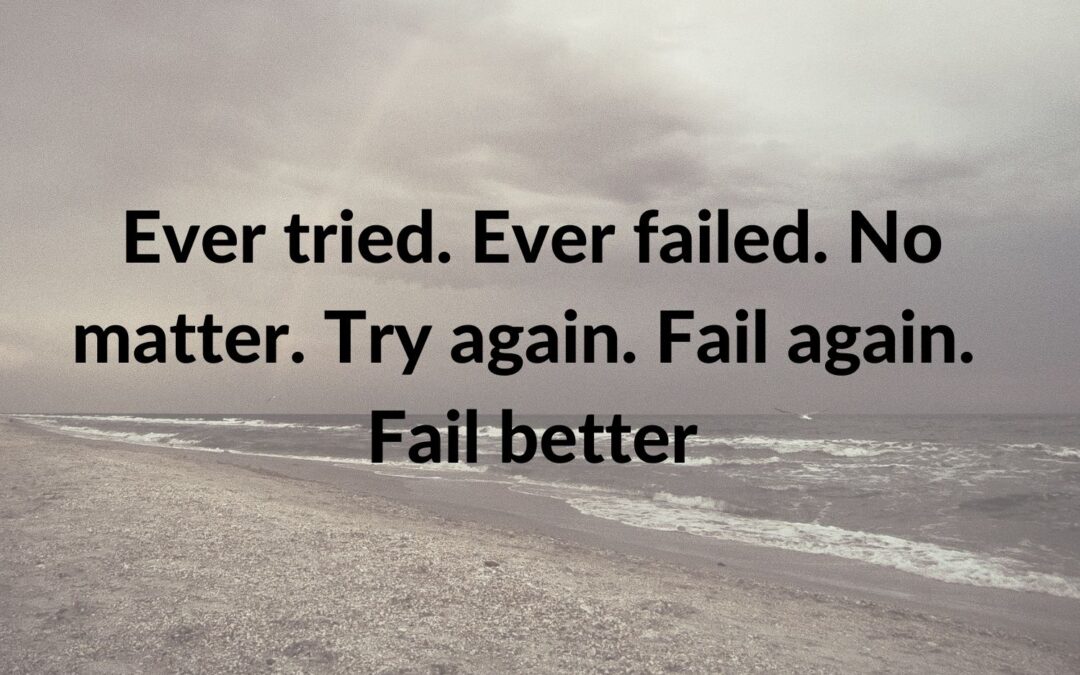
If you need a handy reminder of this, you could do worse than keeping a copy of Samuel Beckett’s famous quote from “Worstward Ho!” nearby for reference.*

All effective leaders have someone with whom they discuss their ideas, check their thinking and generally use as a critical friend or confidant.  It can be lonely as a leader, even of a high-performing team (when everyone wants to be your mate).  If you could use a confidante and would value someone holding up the mirror to your thoughts from time to time, you might like to get in touch.  We can discuss how I can help you to build your high-performing team … and to learn when you fail.


* The quote is in the cover image to this blog.  It should be noted that Beckett’s quote is actually only a snippet of the original piece of prose.  The full piece appears to use this wording as an ironic, perhaps even sardonic, commentary on optimism in the face of supreme difficulty. Maybe that can be a metaphor …


How do team turnarounds happen?

How do team turnarounds happen?

Have you ever wondered how a “team turnaround” actually happens? I did too … until I enabled my first one.

In this blog I explore how I learned lessons that I have been able to apply to teams throughout my career as a change agent.

Starting at the beginning …

So how do team turnarounds happen?  Here’s how I started.  I was new in a leadership role, with a range of services to run, and the key one was … well … a bit “meh”, to be honest. It was performing adequately, but only adequately. I had inherited a management team who had worked for the same gent for years. The service had become too settled, too set in its ways. It also focused too much on its own standards, and not those of its customers.  It was a team turnaround waiting to happen … but I didn’t know that yet.

When I came into the office on that first day, I sat at a spare desk. “But there’s an office over here in the corner we cleared for you. It’s where [previous manager] used to sit”, the team said. They assumed … wanted, perhaps, that things would go on as they had. I explained that I was used to sitting in an open plan office and I would prefer to continue to do so.

Of course, by sitting among the team I could find out much more about the team and the service. I was open about this. And I was not snooping, eavesdropping or secretly judging. I explained to the team that I needed to learn about their service, so I needed to hear it all. The good, the bad, the jokes and the moans (including that I was too noisy in the office). And so I listened. For a month, I listened.

In that month I learned so much. I learned how the service ticked, what made it tick, who made it tick … and who didn’t. I also learned how little they measured, or at least how little attention they paid to the things they did measure. They measured performance statistics which did not resonate with the leadership team and the staff, but which they had to report to industry leaders elsewhere in the country. No one felt they had a stake in improvement. That meant no one felt they needed to improve. No one, except “Peter”.

“Peter” had looked at me sideways when I joined. He sized me up. He answered my questions, and then asked me questions of his own. And he listened, and watched me listen. Then one day, “Peter” came to talk to me. He told me he was frustrated with the lack of modernisation in the service, and the lack of focus on the industry targets was driving him mad.

As I spent a bit more time with the team, it was clear there was one person who had effectively been in charge, said he didn’t want to be in charge, but who took every opportunity to oppose progress. Let’s call him “Tony”. At the other end of the spectrum of opinion was “Peter”, who became increasingly passionate and heated in team meetings about how average the service was, and how great it could be. I could see that the team was polarising, and that my listening and watching had to turn into action.

I had drafted a routemap and it pulled on “Peter’s” ideas. It was clearly not something for me to impose. So I introduced it to the team, setting out the ideas I felt could work. After I finished speaking, I asked them what I had missed.

In that one meeting, the service moved onto its new track. Team members shared opinions and ambitions which they had not felt able to express before.  It soon became clear that there was a continuum, with all of the team together at one end, and then there was “Tony”, alone in his stance at the other.

A tough conversation had to be had, so I booked the meeting room and had The Chat with “Tony”. He was actually really unhappy, and wanted to move on, so we negotiated a helpful exit package, and he left. We held open recruitment for a lead for the team to work with me – and we selected “Peter” unanimously.


The team turnaround starts to happen

The new roadmap meeting had enabled me to show the team that they did not exist to keep the service going, but that they existed to keep the service growing for its customers. By revisiting and re-affirming the service’s purpose, the team then built a shared vision for the first time. No one had involved the team in setting the strategic direction up until that time. We soon changed that, and they began to grow into their new leadership roles, relishing new challenges and new opportunities as they re-aligned staff and teams at the front line, to better serve the customers.

That meeting also achieved an important development – engaging the team in measuring the performance indicators, because they mattered to the team, because the results mattered to their customers.


How the team turned around

After that, our progress was a shared rise to being a high performing team. I supported and reminded, and occasionally reaffirmed a few boundaries, and the team did all the rest. Each leader had their own performance targets – ones they had devised and agreed. I encouraged each leader to work with their own teams to own and meet the targets. The whole service came together, the team leaders presented their agreed aims and progress, and I was able to support them as their facilitator.

For the first time, the whole service was operating as one, agreeing their direction, acknowledging their successes and challenges as one. They were – WE were – all a high-performing team. A team turnaround completed as a shared endeavour.


How did we know that we had a team turnaround on our hands?

Two simple measures:

  1. Customer feedback via regular surveys improved hugely, reflecting the modernisation of the front-line spaces, which the teams organised around customer requirements in ways that “Peter” had set out only a few months previously.
  2. And remember those industry performance measures? “Peter” came to my desk one day with a copy of the latest performance statistics document. We had, together, moved the service from an average performance to one of the best performing services in the industry.

Through the hard work by “Peter”, his team and whole service, they remain one of the top performers in the UK, with other services coming to visit them to see how they do what they do so well.


I hope this case study helps you understand how a team turnaround happens, without too much angst and actually with a huge amount of team buy-in and ownership.  There is no secret sauce.  It is perfectly possible, and actually pretty straightforward, if you have three key ingredients: the right people; the shared vision; and the appetite to put in the hard work to make it happen. As a leader, it is my view that it is your responsibility to nurture all three ingredients. Do that, and you will be on your way.

I now coach leaders to achieve results, and I work with teams to help them improve from within. If you are facing challenges in your team, and want to discuss how I could help, please get in touch, and let’s have a conversation

#teamturnaround #teamcoaching #teamengagement #leadership