How leaders use failure.

How leaders use failure.

In this blog I explore how leaders use failure in their leadership skillset.  I will argue that when they do, they are in a great place to start building and leading a high-performing team.

Wait – what?  How they USE FAILURE?

That’s right.  Failure is not the same as slow success.  I am defining failure here as 100% foul-up, errors and not doing things properly.  Failure is really easy to allow.  You can simply be too busy to keep sufficient attention on the elements of your team’s work that really matter, either to the customer or to your organisation.  Or your team may not know how to do what it needs to do.  OR you might not know, either how to do it, or how to explain it – or even how to spot the signs others don’t know.

So it’s about being attentive to details?

Yes, but that isn’t all of it.  You need an attention to detail, for sure, but you also need to understand why you’re all doing what you’re doing.  It is important for you understand the strategic context and direction for your organisation.  Add to that engaging your team in the vision and journey and you will have your big picture, your vision, your goal.  This gives you your collective “why” (please see another of my blogs to get some ideas about this topic).  It is not enough to understand why you all need to do what you do, to prevent failure.  It is, however, very hard to succeed 100% if you don’t.

It’s also about learning.  As a leader, you need to learn all the time, so you can make your leadership better, every day.  David Kirk, in his classic article for McKinsey, refers to several elements for a high-performing team.  Two resonate particularly with me: what he calls “divine discontent” (the constant hunger for improvement and further knowledge which characterises the most successful leaders); and “lack of mistakes”.

Lack of mistakes is pretty basic – it is what it says it is.  Not making mistakes means not failing, correct?

Not exactly.  In order for your high-performing team not to make mistakes, and thus not fail, there are a myriad of other elements which come into play.  It’s the attention to detail, the lack of errors, the understanding of the collective direction as we have mentioned here.  It is also having the right people, doing the right things well, sufficiently.

There also needs to be a policy framework which allows the improvement to “high-performing” – red tape can really hamper innovation – if you let it.

And, as a coaching colleague reminded me on a recent post of mine, there is also the important imponderable element – luck.

So the next time you fail, don’t beat yourself up as a leader.  Use failure.  Take the learning, learn the learning, and do it better next time.  Be forensic and specific.  Take your time to examine what went wrong.  Avoid the knee-jerk lurch to the other end of whatever choice spectrum you used last time.

First, check it WAS a failure.  Was it a complete disaster, or are you being a perfectionist too early in your team’s development? (Is this possible?  I would be interested in your thoughts about whether, on the way to leading a high performing team, with an agile mindset, the pursuit of excellence can ever be too early).

What worked?  Some things will have gone well, so make sure you keep them and build them into your learning.  And understand WHY things went wrong.  It might have been lack of information, or bad timing, or poor leadership by you or a colleague.  Heavy workloads or poor prioritisation of resources might have played a part.  It could also have been really bad luck.

Whatever the cause of the perceived failure, share your analysis process and learning with your team.  Seek to establish a no-blame learning culture.  This is where colleagues collaborate to build better systems and processes to achieve better collective results.  Such a culture would build the ideal foundations for the high-performing team you want to lead.  Your people will surprise and delight you with their bravery – and their successes.  The fewer mistakes you all make, the closer you will all be toward your goal of high performance and success.

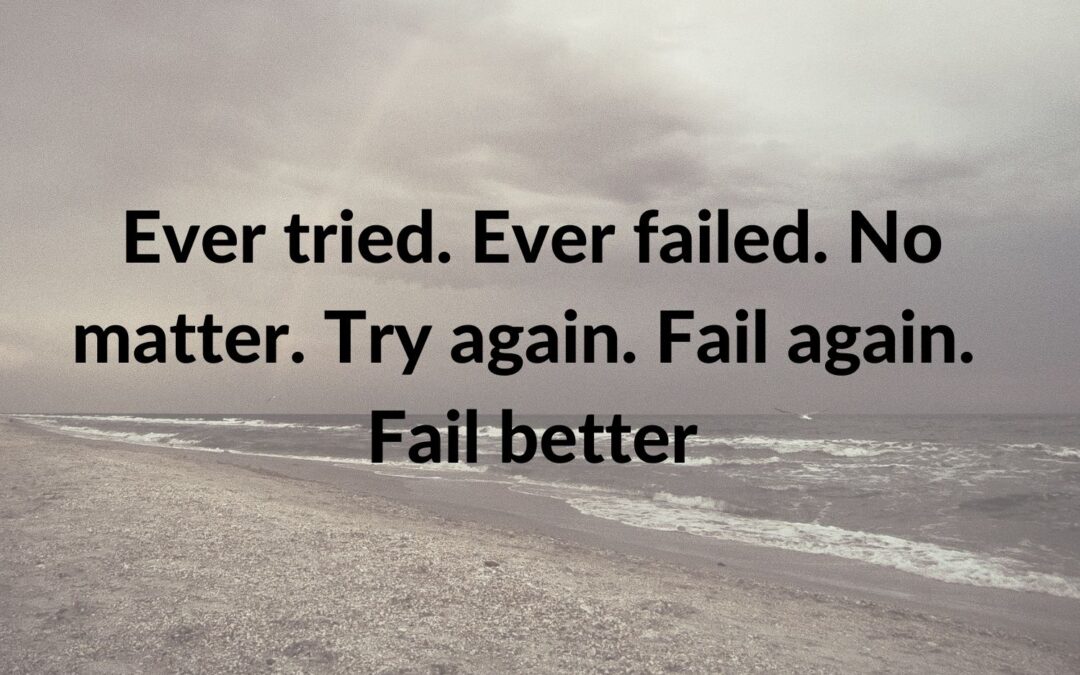
If you need a handy reminder of this, you could do worse than keeping a copy of Samuel Beckett’s famous quote from “Worstward Ho!” nearby for reference.*

All effective leaders have someone with whom they discuss their ideas, check their thinking and generally use as a critical friend or confidant.  It can be lonely as a leader, even of a high-performing team (when everyone wants to be your mate).  If you could use a confidante and would value someone holding up the mirror to your thoughts from time to time, you might like to get in touch.  We can discuss how I can help you to build your high-performing team … and to learn when you fail.


* The quote is in the cover image to this blog.  It should be noted that Beckett’s quote is actually only a snippet of the original piece of prose.  The full piece appears to use this wording as an ironic, perhaps even sardonic, commentary on optimism in the face of supreme difficulty. Maybe that can be a metaphor …


How do team turnarounds happen?

How do team turnarounds happen?

Have you ever wondered how a “team turnaround” actually happens? I did too … until I enabled my first one.

In this blog I explore how I learned lessons that I have been able to apply to teams throughout my career as a change agent.

Starting at the beginning …

So how do team turnarounds happen?  Here’s how I started.  I was new in a leadership role, with a range of services to run, and the key one was … well … a bit “meh”, to be honest. It was performing adequately, but only adequately. I had inherited a management team who had worked for the same gent for years. The service had become too settled, too set in its ways. It also focused too much on its own standards, and not those of its customers.  It was a team turnaround waiting to happen … but I didn’t know that yet.

When I came into the office on that first day, I sat at a spare desk. “But there’s an office over here in the corner we cleared for you. It’s where [previous manager] used to sit”, the team said. They assumed … wanted, perhaps, that things would go on as they had. I explained that I was used to sitting in an open plan office and I would prefer to continue to do so.

Of course, by sitting among the team I could find out much more about the team and the service. I was open about this. And I was not snooping, eavesdropping or secretly judging. I explained to the team that I needed to learn about their service, so I needed to hear it all. The good, the bad, the jokes and the moans (including that I was too noisy in the office). And so I listened. For a month, I listened.

In that month I learned so much. I learned how the service ticked, what made it tick, who made it tick … and who didn’t. I also learned how little they measured, or at least how little attention they paid to the things they did measure. They measured performance statistics which did not resonate with the leadership team and the staff, but which they had to report to industry leaders elsewhere in the country. No one felt they had a stake in improvement. That meant no one felt they needed to improve. No one, except “Peter”.

“Peter” had looked at me sideways when I joined. He sized me up. He answered my questions, and then asked me questions of his own. And he listened, and watched me listen. Then one day, “Peter” came to talk to me. He told me he was frustrated with the lack of modernisation in the service, and the lack of focus on the industry targets was driving him mad.

As I spent a bit more time with the team, it was clear there was one person who had effectively been in charge, said he didn’t want to be in charge, but who took every opportunity to oppose progress. Let’s call him “Tony”. At the other end of the spectrum of opinion was “Peter”, who became increasingly passionate and heated in team meetings about how average the service was, and how great it could be. I could see that the team was polarising, and that my listening and watching had to turn into action.

I had drafted a routemap and it pulled on “Peter’s” ideas. It was clearly not something for me to impose. So I introduced it to the team, setting out the ideas I felt could work. After I finished speaking, I asked them what I had missed.

In that one meeting, the service moved onto its new track. Team members shared opinions and ambitions which they had not felt able to express before.  It soon became clear that there was a continuum, with all of the team together at one end, and then there was “Tony”, alone in his stance at the other.

A tough conversation had to be had, so I booked the meeting room and had The Chat with “Tony”. He was actually really unhappy, and wanted to move on, so we negotiated a helpful exit package, and he left. We held open recruitment for a lead for the team to work with me – and we selected “Peter” unanimously.


The team turnaround starts to happen

The new roadmap meeting had enabled me to show the team that they did not exist to keep the service going, but that they existed to keep the service growing for its customers. By revisiting and re-affirming the service’s purpose, the team then built a shared vision for the first time. No one had involved the team in setting the strategic direction up until that time. We soon changed that, and they began to grow into their new leadership roles, relishing new challenges and new opportunities as they re-aligned staff and teams at the front line, to better serve the customers.

That meeting also achieved an important development – engaging the team in measuring the performance indicators, because they mattered to the team, because the results mattered to their customers.


How the team turned around

After that, our progress was a shared rise to being a high performing team. I supported and reminded, and occasionally reaffirmed a few boundaries, and the team did all the rest. Each leader had their own performance targets – ones they had devised and agreed. I encouraged each leader to work with their own teams to own and meet the targets. The whole service came together, the team leaders presented their agreed aims and progress, and I was able to support them as their facilitator.

For the first time, the whole service was operating as one, agreeing their direction, acknowledging their successes and challenges as one. They were – WE were – all a high-performing team. A team turnaround completed as a shared endeavour.


How did we know that we had a team turnaround on our hands?

Two simple measures:

  1. Customer feedback via regular surveys improved hugely, reflecting the modernisation of the front-line spaces, which the teams organised around customer requirements in ways that “Peter” had set out only a few months previously.
  2. And remember those industry performance measures? “Peter” came to my desk one day with a copy of the latest performance statistics document. We had, together, moved the service from an average performance to one of the best performing services in the industry.

Through the hard work by “Peter”, his team and whole service, they remain one of the top performers in the UK, with other services coming to visit them to see how they do what they do so well.


I hope this case study helps you understand how a team turnaround happens, without too much angst and actually with a huge amount of team buy-in and ownership.  There is no secret sauce.  It is perfectly possible, and actually pretty straightforward, if you have three key ingredients: the right people; the shared vision; and the appetite to put in the hard work to make it happen. As a leader, it is my view that it is your responsibility to nurture all three ingredients. Do that, and you will be on your way.

I now coach leaders to achieve results, and I work with teams to help them improve from within. If you are facing challenges in your team, and want to discuss how I could help, please get in touch, and let’s have a conversation

#teamturnaround #teamcoaching #teamengagement #leadership

What gets you out of bed in the morning? Your “Why?”?

What gets you out of bed in the morning? Your “Why?”?

What gets you out of bed in the morning? Why your “WHY?” is so important.

Simon Sinek is famous for the third most popular TED talk of all time, based on his book Start with Why. (Given its continued value, relevance and ubiquity, makes you wonder what the top two are*)

Mr Sinek says this about his decision to highlight the importance of purpose:

In 2009 … [I] started a movement to help people become more inspired at work, and in turn inspire their colleagues and customers … People like Martin Luther King Jr., Steve Jobs, and the Wright Brothers had little in common, but they all started with WHY. They realized that people won’t truly buy into a product, service, movement, or idea until they understand the WHY behind it.

Mine is a crude paraphrase of his explanation of the birth of his bestseller, Start with Why. It does, however, make the point.

You need to know WHY you are doing something, for others to want to follow you, either to work with you or to buy from you. What is your purpose in doing what you do?

You also need to be clear about your reasons for doing what you do, when you are a leader. Why should your team follow you? After all, just because something is of burning importance to you, it doesn’t follow that they have to be obsessed with it too. Something which fires and inspires you may well be a damp squib for others.

Unless …

Unless the people you are seeking to inspire can see not only the reason behind the thing that inspires you AND the impact that has on you. What are the benefits? How does it make you feel?

And that’s the important bit. It’s not the reason. In fact, it’s the way the reason makes you feel (with apologies to the late Maya Angelou) that makes the real difference.

When people are busy, with stressful lives, full diaries and then the external pressures of things like hardship, environmental concerns and, of course, the pandemic, motivation can be a real problem. You can look at Mazlow, you can cite Herzberg … but if you’re not “feeling it” then you’re not going to be motivated.

That goes for you as a leader, and it goes for every one of the people you lead. Why should they follow you? Money, hierarchy, power all influence, of course. They don’t get people out of bed in the morning with anything other than reluctance, however, if those people don’t feel that your leadership motivation is working for them, they simply won’t follow you. And you can only be a leader when people are prepared to be led.

So, you can simply tell people why YOU like x,y,z and how it makes YOU feel, and that’s the problem solved, right?

Nope.

It is, as Maya Angelou said, how you make THEM feel, which is so important. So when you are using your own motivation as the tool to motivate your team, you need to remember what is going on for THEM, as well as for yourself. Watch, listen and learn what motivates different people to achieve different things, at different times? Every team will be super-successful with a focus on diversity, most importantly diversity of thought. That translates as diversity of motivation, or different strokes for different folks, as it’s often said.

How can you find out what motivates your team? How about asking them? And how about asking them what is important to them, rather than what motivates them? Get to know your team. Learn how your team tick as individuals, as well as the collective whole. Get to know your team’s Why.

If you would like to know how to motivate your team (and maybe yourself) better, it only takes a quick chat with me to check we’re compatible.  That chat is 100% free and 100% confidential. No-one will know you’ve been in touch, so no-one will know you asked for help.  (Asking for help is a massive STRENGTH, by the way, but that’s another blog …).  It’s OK not to have have all the answers. Leaders with all the answers are unicorns. Just saying …

Nomatter the need for secrecy or your confidence in your ability to show your team you care and want do to the best for them, leadership coaching will really help. Your team will benefit indirectly, which means your customers will too, so you will benefit from growth all over again. 360’ of wins! Please get in touch, and let’s get you started on finding your Why?

* The top two are, by the late and great Sir Ken Robinson, on whether schools kill creativity in our children, and the famous talk by Prof Amy Cuddy on body language and posing which still has people talking to this day.

Drum Roll … the new website is launched!

Drum Roll … the new website is launched!

If you want to know about my company’s services, it’s now even easier – with our shiny new website!

For some years, I had had websites which did the job and I am grateful for the support in their development (and continued hosting) to Artisan Internet. However, the time had come to integrate the Astrid Davies Consulting website with other aligned sites such as Aspire4Business. Therefore, who better to turn to, to help me redesign the site than Jayne Caudle?   She is the developer behind the successful Aspire4Business suite of sites.

The impact? An immediate increase in bot activity!  Pedro the Peruvian bot, my lonely regular interaction on my old site, has competition.

Actually, in all seriousness, the new site has already yielded two expressions of interest in my company’s services.  In addition, those of my contacts who have had a look have come back with a range of positives, mostly that they love the clean look, unmistakable branding and the clear way the company’s services are set out.

Interestingly, a few of my contacts have commented that the site helped them find out much more about what we all do here at ADCL.  It tells them with and for whom we work.  It also tells them how we do it. In other words, the website is explaining my company’s offer.  Whether you fancy executive coaching, leadership and career mentoring, leadership development, profiling or the fast-growing Future Leaders Breakfast networking product, we can clearly help.

The point really is – the website and service clarity is new, but the quality and commitment to your leadership journey are still as high as ever.

It’s not just about the site, tho’

There’s a wider message here. New shiny packaging can attract and sell.  It will get your attention. It will hopefully intrigue you and invite you to think how you can use the product or service in that shiny packaging. However, the product or service HAS to be good quality and reliably sound. You have to be able to see how you could use that quality. You have to understand the benefits you could see, for yourself and your business. Some of that can come from that shiny packaging being clear. A lot of your ability to see the benefits, however, has to come from you knowing what you want and need.

Knowing what you want and need is crucial for your business success – but it isn’t always easy.  And that’s the key.  Asking for help, or simply kicking ideas around with a trusted confidante, can help you to order your thoughts, and clarify your priorities.

So if you would find it helpful, to have a chat about what is troubling you in your business, please get in touch.

100% confidential. 100% free for your initial chat. Zero obligation. 100% focused on helping you to help yourself.

Shiny new website, same high quality support.

Image: courtesy of rawpixel via Unsplash

Reflections on 2020 – a lost year?

Reflections on 2020 – a lost year?

I am writing this on New Year’s Eve, December 31st 2020, joining in what is probably a world-wide reflection on the past year and the fact that, for most, it was a shocker.

Does that mean, however, that it was a lost year, as some have described it?  I would beg to differ.  I think whatever life throws at you, offers you some “lovely learning” as a tutor of mine once said.  This may sound worthy, but I am with Einstein, who apparently said that when you stop learning, you start dying.

So, what have I learned, on the basis of this reflection?  Firstly, that I am a misanthrope, mistrustful of my fellow citizens as they have taken fewer anti-Covid precautions than me and who have on occasions been pretty aggressive about their right to infect me with the hidden dangers of the pandemic.

Secondly, despite my misanthropic viewpoint, I have come to realise with fervent gratitude that there really ARE some truly wonderful people out there, and I am thankful they exist and do what they do so splendidly.  NHS workers at all levels, carers and social workers, teachers, police, bin collectors, voluntary sector key workers, fire fighters and even Service personnel, drafted in sometimes to provide reinforcements during the pandemic.  All of these people and many more found themselves in the front line in the fight against the pandemic, and they did so voluntarily, unselfishly and bravely.  Worth recognition with something more lasting and material than a few token-gesture claps, in my view.

Thirdly, I have learned that, sadly, my misanthropy is still well-placed, with the people who have still stolen, still harmed others, still acted appallingly to employees, still failed to lead on a catastrophic level and generally failed to behave decently to others throughout 2020.  The incidence of domestic violence has risen and mental ill-health is at record levels – both these acute needs for state action have been exacerbated by pathetic levels of resourcing at a national level which has then been further whittled away at the local level.  Some people have still scammed the vulnerable, exploiting older people’s lack of savvy when it comes to online.  Some people have maintained their narrow racist, homophobic and misogynist views and promoted them ever wider because more lockdown time allowed more time to troll.  And I am targeting my comments at national politicians as much as keyboard-warrior saddos.  How sad that is even A Thing.

Fourth, and perhaps most importantly of all, I have found that all the trite verbiage about “the human spirit” from this past year may, just may, be true.  I have seen better understanding between local residents previously riven by Brexit and other rival causes.  I have seen better communication between organisations and their customers (“need to know” really streamlines those marketing puff emails).  Most intriguingly, I have seen ordinary people envisage extraordinary things, and then achieve them – even exceed them in the case of Capt Sir Tom Moore and many other fundraisers throughout the year.  A lot of people, doing great things quietly, without a massive impact, but doing what they could to make things a bit better for themselves and those around them.  Often, I have seen this, either in person or via media, as someone embarrassedly shrugging and saying “well, it’s nothing really – you just do what you can”.  And yet, doing what they could has meant the world to someone else.  By doing something differently, checking what was needed to make the most immediate difference, being brave enough to give something a try, in the hope it would work but willing to accept if it didn’t … and then try something else again.

And what makes them prepared to keep on trying to succeed?  For some, it may be indomitable spirit.  For others, it could be blind, dogged, stubbornness.  I am hopeful, however, that for some others, they have discovered their leadership capabilities – understanding that they could make life better for and with people.  By believing that something is always possible, with lots of hard work, determination and joining forces with others, these latent leaders have created mini-miracles, across the UK and around the world, every day.

That’s a lovely thought and one that will sustain me through 2021, whatever it throws at us.

And if you know that you have that leadership talent within you, but you’re not too sure how to find it and let it out, I can help with that.  We can have a chat, explore your ideas, and if you like how we work together, we can craft a plan to get you leading, succeeding and, most importantly, believing.  Please get in touch to find out more.

Image courtesy of cottonbro via pexels.com